News
Friday, January 9, 2026
Call for Individual Papers, Presentations, and Creative Contributions: Creative Practices and Bridging the Invisible
This CFP may also be viewed here and the submission form may be viewed here. Panel submissions should be sent directly to the panel chairs.
The Department of Art + Art History and The Center for the Study of Ideas and Practices at the University of North Carolina at Charlotte, in co-sponsorship with The Center for Advanced Studies – Erlangen, The University of Exeter’s Centre for Magic and Esotericism, and Societas Magica are pleased to announce the general call for submissions from scholars and creative practitioners.
The inaugural theme is: Creative Practices and Bridging the Invisible and will be held online from October 15th-17th, 2026.
It will also occur in tandem with the art exhibition Holding a Bright, Untroubled Sky: Visioning a Better World through Magic held in the Rowe Galleries at the University of North Carolina at Charlotte and curated by Dr. Amy Hale.
We are considering creative and aesthetic practices broadly: visual arts, design, digital technologies, crafts, music, dance, performance, poetry, architecture, and more.
Suggested topics include:
- – connections between historical or contemporary practices and beliefs
- – creative disciplines and disciplines and ways of knowing and belief systems
- – generative AI and current understandings of consciousness, belief systems, and creative practices
- – cross-disciplinary discourse in ways of knowing, studies of practices and beliefs, and creative practices
We invite submissions for the following through March 2nd, 2026:
- Individual Research Papers (20-minute or 40-minute)
- Roundtables (1 hour, max 6 participants plus convener)
- Creative Talks (aka, Artist Talks) (20-minute or 40-minute)
- ‘Creative Experiences’ (20-minute or 40-minute for synchronous performances or workshops; any duration for asynchronous presentations.)
- Panel Presentation (please see specific listings on the next page)
Key Dates:
- March 2, 2026 – Deadline for proposals (see next page for details).
- May 1, 2026 – Accepted presentations confirmed.
- June 1, 2026 – Draft program available.
- August 6, 2026 – Final program available.
- October 15-17, 2026 – Conference dates.
Final registration fees will be announced by August 1, 2026, and will be on a sliding scale from $0 to $20. Fees will be based on the amount needed to cover conference costs.
Inquiries and questions may be directed to Prof. Heather D. Freeman at heatherfreeman@charlotte.edu or heatherfreemanartist@gmail.com.
General Submissions Please see the panel sessions below before submitting an individual paper. Submissions for individual research papers, roundtables (complete panels), creative talks (artist talks), and ‘creative experiences’ (which encourage interpretation!) should be submitted via this Google Form by March 2nd, 2026. |
Panel Session Submissions
Email abstracts (~ 200-300 words) and questions to the individual Panel Chairs. Individual presentations will be roughly 15-20 minutes, with 3-4 individuals per panel. Submissions must be emailed to panel chairs by March 2nd, 2026.
Panel 1: Architecture of the Invisible and Invisible Architecture
Chair: Andrea Franchetto, andrea.franchetto@rel.su.se
The panel invites proposals that explore the dynamic relationship between architecture and the Invisible, as understood through its various forms in esoteric, magical, and spiritual practices. It aims to examine how physical architecture serves as a medium for the invisible and how magical/esoteric practices give rise to invisible architecture. The historical scope of the panel is broad, welcoming contributions from antiquity to the present day. It also encourages participation from researchers and practitioners in the arts who are interested in integrating the invisible with architectural expression.
Panel 2: Hypnosis Between Science and Magic
Co-Chairs: Deborah Edmeades deborah.edmeades@gmail.com and Sol Hashemi solhashemi@gmail.com
Using the title of Isabelle Stengers’ 2002 book as a jumping-off point and drawing on the historical legacy of hypnosis—from a model of alternate (and open-ended) consciousness to contemporary doctrines such as “creating your own reality”—we’re interested in exploring how hypnosis moves between science and belief, and what its shifting role might tell us about perception, agency, and imagination. We welcome contributions that are performative or demonstrative in nature—such as performance lectures or hybrid presentations that enact or model hypnotic processes.
Panel 3: Artistic and Cultural Approaches to Herbalism, Healing, and Gnosis
Chair: Jordan A. Fenton fentonja@miamioh.edu
Commonly positioned within the tropes of sorcery, magic, witchcraft, and the occult, this panel examines the understudied topics and themes of herbalism, what has been coined as alternative forms of healing, and other cultural practices that hinge on esoteric knowledge. The aim of this panel is to make sense of the often invisible, intangible, and the uncanny by linking expressive culture to these cultural phenomena. Few have explored these topics (save for divination) through the lenses of artistic, cultural, and humanist perspectives, which is what this panel aims to accomplish in our attempt to untether them from misconstrued tropes that has led to a type of epistemological otherness.
Panel 4: Spirit Voices: AI Music Creation as Spiritual and Creative Practice
Chair: Justin Cary jcary1@charlotte.edu
Near the turn of the 20th century, William Mumler amazed New York with a startling new technology; The Spirit Camera. A new wonder capable of capturing the ghostly visage of recently deceased loved ones, Mumler’s modern marvel amazed audiences with its seemingly magical, otherworldly capabilities. This panel will look forward by looking back and exploring the emerging role of generative Artificial Intelligence in the creation of musical audio production by specifically examining the synthesis of AI-generated musical compositions with human-authored lyrics and structured writing, as a contemporary spiritual practice. Drawing direct connections to the late 19th-century phenomenon of spirit photography espoused by figures like Mumler, the question will be posed to modern audiences in the same way it was posed in 1870: is AI music a form of modern spiritual transcendence, evoking a ‘spirit voice’ or is it elaborate charlatanism…and ultimately, do these distinctions matter in esoteric practice?
By examining the concepts of magic, esotericism, and the nature of the unseen source of creativity, this talk will position AI’s ability to pull “reality” from vast, non-human data sets as a new kind of spiritualism, connecting the cultural marginality of esoteric practice and the current cultural marginality of AI creative practice.
When AI produces music that feels meaningful, haunted, or unpredictable, are we experiencing true technological transcendence, or simply the digital equivalent of a parlor trick? This cross-disciplinary analysis provides a foundational framework for understanding the ethical, creative, and philosophical value of AI-generated media through the lens of magic and esotericism, raising questions about precisely who becomes culturally marginalized in AI creative practice, the complex alterity of AI’s impact on the physical world and the often unseen threads between the ‘magic’ of AI and the tangible impact on real communities, practitioners and humans both positive and negative. This panel invites a variety of viewpoints and perspectives on the use of generative AI in creative practice and recognizes the spectrum of views, opinions, and the complex discourse surrounding AI in the creative arts. All perspectives are welcome and all are encouraged to submit to share critical perspectives on this important topic.
Panel 5: Non-modern Technomancy: Ancient Machines and Contemporary Magicks
Co-Chairs: Alan Perryaperry2@saic.eduand Snow Chenschen85@saic.edu
This panel invites artists, theorists, and technologists to explore the entanglement of technology and magick as co-evolving systems of world-making. Rather than tracing a linear progression from the premodern to the modern to the postmodern, we propose a non-modern return in which machines, rituals, and symbols mutually generate the visible and invisible. From medieval automata once believed to house spirits to early theurgy, and again to contemporary algorithmic meme-based manifestations of desire, the machinic has long served as a vessel for metaphysical speculation.
We seek presentations that situate creative practice drawing on esoteric and/or occult tradition as a form of historically-informed technomancy. How might poetry function as code? How do physical machines and virtual environments each enact their own cosmologies of control and enchantment, by functioning as magic circles? Participants may address topics such as cyber-occultism, animism in robotics, techno-alchemy, procedural ritual, and the aesthetics of mechanical awe.
This panel aims to “bridge the invisible” by challenging disciplinary and temporal boundaries. We aim to situate contemporary digital art within lineages of sacred craft and premodern metaphysics. By collapsing distinctions between the mechanical and the magical, participants will reimagine technology not as disenchantment but as a site of re-enchantment of silicon, symbol, and spirit. Hybrid participation is encouraged to reflect the fluid thresholds between the physical and the virtual.
Panel 6: Beyond the Western Occult: Decolonizing Global Esoterica
Co-Chairs: Alan Perryaperry2@saic.edu, Snow Chenschen85@saic.edu
This panel calls for post-colonial and cross-cultural approaches to magic, esotericism, and creative practice. Western occult traditions, such as hermeticism, Western alchemy, or ritual magic, have long dominated global discourses of mysticism and art. Yet parallel cosmologies, from Daoist alchemy and Tantric visualization to Yoruba divination and Andean ritual craft, propose radically different ontologies of the invisible.
“Beyond the Western Occult” convenes artists and scholars who engage these plural traditions not as exotic others but as living, adaptive systems of knowledge. Presentations may address digital and performative practices that remix or reclaim indigenous and non-Western magical systems, interrogate orientalist tropes, or explore diasporic strategies of spiritual resistance.
By situating esoteric creativity within post-colonial critique, this panel seeks to unmake the invisible hierarchies embedded in the very category of “the occult.” Participants will consider how global emerging technologies, like AI, networks, digital archives, can amplify, hybridize, or decolonize magical expression. The panel’s hybrid format mirrors the transcultural and telematic circulation of images, symbols, and spirits that continue to shape our digital present.
Panel 7: Magic and Artivism as Resistance
Co-Chairs: Giovanna Parmigiani gparmigiani@hds.harvard.edu and Olivia Cejvan olivia.cejvan@mau.se
Art has long been a site of political imagination and resistance. From feminist performances and decolonial installations to protest songs and digital activism, artistic practices have offered spaces to question authority, reconfigure social relations, and prefigure alternative futures. Artivism—where art and activism converge—uses aesthetic forms to intervene in the political field, mobilizing affect, embodiment, and creativity as tools of resistance and care.
Magic, like art, has long been understood as a technology of transformation. Anthropologists and theorists—from Alfred Gell to Michael Taussig and Tim Ingold—have emphasized how both art and magic act upon the world rather than merely represent it. Each involves processes of making that blur the distinction between material and immaterial, form and force. Through symbols, gestures, sound, and image, magical and artistic practices generate affective and perceptual shifts, cultivating new relations between humans and more-than-human worlds. Both can thus be seen as aesthetic modes of action—ways of transforming reality through the reorganization of perception, imagination, and embodied practice.
In this panel, we explore the connections between magic and activism through the lens of aesthetics, understood not only as art but as sensory engagement with the world. We ask: how do magical and artistic practices intervene in political processes, unsettle dominant orders, and expand what can be felt and known? How do contemporary practitioners—artists, witches, healers, musicians, designers, digital creators, and activists—mobilize aesthetic and sensory forms to cultivate presence, solidarity, and transformation?
Bringing together anthropologists, artists, and scholars of religion, media, and cultural studies, this panel invites discussion of magic artivism as a politics of the sensible. Through ethnographic, artistic, and theoretical contributions, we examine how spells, performances, installations, fashion statements, and rituals—from street protests to viral images—open spaces of resistance and renewal. The panel foregrounds the aesthetic dimensions of activism and the political potential of magic, tracing how art, theologies, and popular media engages with feminist, queer, and decolonial struggles to re-enchant political imagination and blur the boundaries between ritual, creativity, and resistance.
Monday, December 1, 2025
Update on Creative Practices and Bridging the Invisible
This conference will now be held fully online. The call for individual papers and creative works that may be shared synchronously or asynchronously online will go out shortly.
Monday, October 6th, 2025
Call for Panel Proposals: Creative Practices and Bridging the Invisible
The Department of Art + Art History and The Center for the Study of Ideas and Practices at the University of North Carolina at Charlotte, in co-sponsorship with The Center for Advanced Studies – Erlangen, The University of Exeter’s Centre for Magic and Esotericism, and Societas Magica are pleased to announce a call for panels for its first annual conference.
The inaugural theme is: Creative Practices and Bridging the Invisible.
We invite proposals for panels from scholars and creative practitioners alike. The conference will take place b̶o̶t̶h̶ ̶i̶n̶ ̶p̶e̶r̶s̶o̶n̶ ̶a̶n̶d̶ online at the University of North Carolina at Charlotte from Thursday, October 15th to Saturday, October 17th, 2026, in tandem with the art exhibition Holding a Bright, Untroubled Sky: Visioning a Better World through Magic, curated by Dr. Amy Hale.
We are considering creative and aesthetic practices broadly: visual arts, design, digital technologies, crafts, music, dance, performance, poetry, architecture, and more.
Suggested topics include:
• connections between historical or contemporary practices and beliefs
• creative disciplines and disciplines and ways of knowing and belief systems
• generative AI and current understandings of consciousness, belief systems, and creative practices
• cross-disciplinary discourse in ways of knowing, studies of practices and beliefs, and creative practices
Submissions
Proposals should include the following information: proposed session title; session format; the organizer’s name, organizer’s affiliation (if applicable), and contact information (up to three organizers per proposal); a roughly 300-word description of the session; a̶n̶d̶ ̶w̶h̶e̶t̶h̶e̶r̶ ̶t̶h̶e̶ ̶s̶e̶s̶s̶i̶o̶n̶ ̶i̶s̶ ̶i̶n̶-̶p̶e̶r̶s̶o̶n̶,̶ ̶o̶n̶l̶i̶n̶e̶,̶ ̶o̶r̶ ̶h̶y̶b̶r̶i̶d̶.̶ ̶(̶H̶y̶b̶r̶i̶d̶ ̶s̶e̶s̶s̶i̶o̶n̶s̶ ̶a̶r̶e̶ ̶s̶t̶r̶o̶n̶g̶l̶y̶ ̶e̶n̶c̶o̶u̶r̶a̶g̶e̶d̶.̶)̶ ̶
Panel proposals should be emailed by Monday, November 3rd, 2025.
Inquiries and proposals may be directed to Prof. Heather D. Freeman at heatherfreeman@charlotte.edu.
Key Dates:
- November 3, 2025 – Panel proposals due.
- December 8, 2025 – Panels confirmed; call for individual papers and presentations announced.
- March 2, 2026 – Paper, general, and other presentation proposals due to panel chairs.
- May 1, 2026 – Accepted papers and other presentations confirmed.
- June 1, 2026 – Draft program ̶a̶n̶d̶ ̶i̶n̶-̶p̶e̶r̶s̶o̶n̶ ̶a̶t̶t̶e̶n̶d̶a̶n̶c̶e̶ ̶i̶n̶f̶o̶r̶m̶a̶t̶i̶o̶n̶ available.
- July 6, 2026 – Participation Confirmation ̶(̶O̶n̶l̶i̶n̶e̶ ̶o̶r̶ ̶I̶n̶-̶P̶e̶r̶s̶o̶n̶)̶.̶ ̶
- October 15-17, 2026 – Conference dates ̶a̶t̶ ̶t̶h̶e̶ ̶U̶n̶i̶v̶e̶r̶s̶i̶t̶y̶ ̶o̶f̶ ̶N̶o̶r̶t̶h̶ ̶C̶a̶r̶o̶l̶i̶n̶a̶ ̶a̶t̶ ̶C̶h̶a̶r̶l̶o̶t̶t̶e̶ ̶a̶n̶d̶ ̶online.
Final registration fees will be announced by June 1, 2026, and will be on a sliding scale from $0 to $20o ̶$̶2̶0̶0̶.̶ ̶
Saturday, February 15th, 2025
Prof. Freeman speaks at the Center for Advanced Studies – Erlangen,
Center Director Heather D. Freeman visited the Center for Advanced Studies- Erlangen (CAS-E), Alternative Rationalities and Esoteric Practices from a Global Perspective group on January 15th. She spoke about public advocacy for humanities research as part of CAS-E’s Winter 2024/2025 lecture series.
In her talk Podcasting and Popular Media as Research Advocacy in Magic and Esoteric Studies, Freeman specifically cited several media reactions to her NEH-funded podcast series Magic in the United States as examples of why scholars need to communicate their research to diverse audiences, and employ popular media forms like podcasts and social media to that end.
A video of the lecture (as well as other CAS-E lectures) may be viewed here. Freeman also contributed a blog-post summary of that lecture for CAS-E’s website.
The CAS-E Alternative Rationalities and Esoteric Practices from a Global Perspective research group “undertakes the investigation of the apparent persistence of practices aimed at predicting, controlling, managing, and manipulating contingent life events, despite an increasingly dominant scientific and technical discourse that delegitimizes them” and their “main goal is to map a global field of research of such practices from a transcultural perspective and to compare the various interpretations, rationalizations, and legitimation strategies used by practitioners and their clients.” Additionally, “equipped with a contemporary and global focus, [they] promote a synergy of approaches from the fields of cultural and social anthropology, religious studies (including the cognitive study of religion and ritual), regional and literary studies, as well as social and political science.” Additional CAS-E blog posts and videos of past lectures may be viewed on their website, https://cas-e.de/.
Sunday, December 1st, 2024
Final Season of “Magic in the United States” Podcast Airs
The final season of Center Director Heather D. Freeman’s podcast series Magic in the United States with PRX aired on November 12, and will release weekly episodes through December 17th. Funded with a $389,000 grant from the National Endowment for the Humanities in 2023, this popular series explores the magical, spiritual, esoteric, mystical, and marginalized religious beliefs and practices of diverse American communities from throughout this nation’s history.
Season 3 began with the origins of the Book of Mormon, the late- 19th century curandera Teresa Urrea, and the Catholic ‘Saint of Sorcery’ Cyprian of Antioch. It will conclude with episodes on the history of astrology in the United States, the media-driven origins of the ‘teen witch’, and the final episode will to future of digital technology, magical practice, and generative AI.
Season 1 presented key ideas behind religious, spiritual, and magical remixing, early pagan BBSes, a murder along Pennsylvania Dutch ‘powwowers’, Spiritualism and Harry Houdini, Root Work, Hoodoo, Conjure, and the Second Great Migration, and the shamanic and magical practices of two Korean-American Millenials.
Season 2 told the history of a Wiccan tradition by and for gay and bisexual men, the Supreme Court case between the City of Hialeah, Florida and the Church of Lukumi Babalu Aye, the origins of ‘manifestation’ and ‘the law of attraction’, an Appalachian folk legend from the 1930s, the history of the Paiute ‘Ghost Dance’, and the story of Anton LaVey and the Church of Satan.
You can hear Magic in the United States for free on Spotify, iHeartRadio, YouTube, Amazon, or wherever you get your podcasts.
Thursday, October 24th, 2024
Launch of Praxis-Knowledge, journal of the Research Network for the Study of Esoteric Practices
RENSEP (The Research Network for the Study of Esoteric Practices) has launched its new, online journal Praxis-Knowledge. The journal embodies RENSEP’s mission as its focus is global, interdisciplinary, praxeological, and experience-oriented. The journal aspires to build bridges between scholars and practitioners and facilitate the co-production of knowledge within the academic study of esoteric practices.
Their first publication is To Reveal the Hidden Kingdom of Eld: Andrew Chumbley, the Cultus Sabbati, and Imaginal Space in Cornwall by Steve Patterson (Independent Researcher) and Jeff Howard (Falmouth University).
Praxis-Knowledge maintains a standardized peer-review process for submissions but does not require academic credentials as a prerequisite for publication. Students, non-affiliated academics, practitioners, and scholar-practitioners are strongly encouraged to collaborate with established scholars in submitting innovative articles that “heighten our understanding of the manifold types of esoteric practices, practice-induced experiences and effects, and esoteric praxis-knowledge.”
The editorial board includes Center Director Heather D. Freeman, as well as notable scholars in diverse disciplines related to the study of magic, esotericism, mysticism, and occulture, including Dr. Jenny Butler (University College Cork), Dr. Ronald Hutton (University of Bristol), and Dr. Emily Selove (University of Exeter) along others.
Praxis-Knowledge does not have separate issues, but all published articles are numbered consecutively. The editorial board will also accept suggestions for special issues. Faculty, students, staff, and regional community members are encouraged to submit content for publication. The journal’s publishing guidelines are available online, and the managing editor can be contacted at aaron.french@rensep.org.
Wednesday, August 14th, 2024
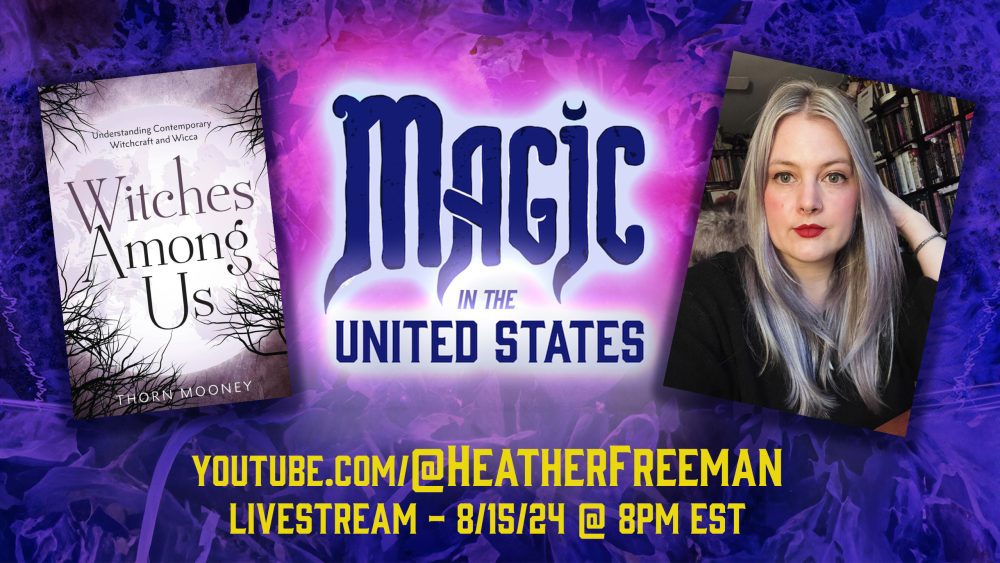
Center Director Heather D. Freeman interviews author and UNC Religious Studies PhD Student Thorn Mooney on YouTube Livestream
Audiences can watch and participate in a YouTube live-stream interview between Center Director and host of the podcast Magic in the United States Heather D. Freeman and author and UNC Religious Studies PhD student Thorn Mooney.
The live stream will start at 8 pm EST, tomorrow, August 15th, 2024 EST at https://www.youtube.com/@HeatherFreeman/. They will discuss Thorn’s third book, Witches Among Us in which Thorn draws on her expertise as a magical practitioner and religious studies scholar to explore the meanings and identities behind contemporary witchcraft practices for non-practitioner and lay audiences. They will also discuss Thorn’s other projects and Season 3 of Magic in the United States. (A recording of the livestream will also be available at a later date.)
Monday, April 22nd, 2024
Dr. Damien Williams presents “Religious Belief and Practice in the Age of AI” at Emory University
**UPDATE: You can watch the video of this talk on YouTube.*
Today at 3 pm Eastern, Dr. Damien Williams will present “Religious Belief and Practice in the Age of AI” at the Pitts Theology Library at Emory University. The event is free, open to the public and both live and live-streamed at https://pitts-emory.libcal.com/event/12014350.
“As part of a seed grant project funded by the AIAI Network, Damien P. Williams, assistant professor of Philosophy and Data Science at the University of North Carolina at Charlotte, will present his research on the intersection of AI and religious belief and practice.
This event is free and open to the public.Dr. Damien Patrick Williams is an Assistant Professor of Data Science and Philosophy at the University of North Carolina at Charlotte, where he teaches and researches how technologies such as algorithms, machine intelligence, and biotechnologies are impacted by the values, knowledge systems, philosophical explorations, social structures, and even religious beliefs of human beings. Damien has a PhD in Science, Technology, and Society from Virginia Tech, and an MA from Georgia State University in Philosophy and Religious Studies, specializing in the intersection of philosophy and the comparative study of religion, with a focus on occult theory and method. Damien’s realms of expertise have led to him serving on the boards of non-profit organizations such as the Center for Democracy and Technology, and the Disability Inclusion Fund, and consulting for several universities and research and development groups such as Olin College and SRI International. He has been interviewed for multiple podcasts, news outlets, and popular publications, including TIME Magazine, and been invited to speak at dozens of international conferences. All of Damien’s research is concerned with how the knowledges and experiences of marginalized peoples affect and should be centered within the technosocial structures of human societies.”
Wednesday, April 3rd, 2024
Freeman talks podcasting and magic with Harvard Divinity School’s Giovanna Parmigiani
On April 10th at 1 pm Eastern, Heather D. Freeman will appear on Gnoseologies an online lecture series hosted by Giovanna Parmigiani. The series is part of Harvard Divinity School’s Center for the Study of World Religions. Freeman and Parmiagiani will discuss the podcast Magic in the United States, magic in the media and academia, and communication with diverse audiences. The talk is free to the public but requires registration.
Tuesday, October 24th, 2023
“Magic in the United States” Podcast Launches
Center for Magic, Esotericism, and Occulture Director Heather D. Freeman was awarded a major grant from the National Endowment for the Humanities in 2023 to produce the podcast series Magic in the United States with PRX. The $389,000 grant will fund three six-episode seasons which explores how magical beliefs and practices have evolved in the U.S. from the 1600s to the present. Launched October 24, 2023 the podcast is available for free through all major podcast outlets. Read more about Freeman and the podcast in this feature story in Queen City Nerve. You can hear a full discussion of the topic on the October 31st broadcast of Charlotte Talks on WFAE 90.7 FM.